Lost in the Pile: How to Actually Know What Baby Gear You Own Before You Buy It Again
Somewhere in your house, there is a baby item you forgot you had. Maybe it's a sound machine shoved under the crib, a swaddle blanket buried in the hall closet, or a bouncer seat that somehow ended up in the garage next to the recycling bins. You probably bought a backup. You might have even bought two.
This is not a parenting failure. It's just physics — baby gear expands to fill every available surface, cabinet, and corner, and once it spreads out far enough, it becomes functionally invisible. The real problem isn't owning too much stuff. It's not knowing what you own, where it is, or whether it still works.
A quick, honest audit of your baby gear situation can save you money, reduce stress, and — maybe most importantly — mean you can actually find the thing you need at 2 a.m. instead of ordering a replacement on your phone while standing in the dark.
Why Baby Gear Goes Missing Without Anyone Noticing
Baby stuff moves constantly in the first year. Something that lived on the nightstand in month one gets relocated to the nursery shelf in month two, then ends up in a tote bag after a weekend trip, then never quite makes it back. Multiply that by every item you own, and you've got a circulation problem.
There's also the gift factor. A lot of parents receive gear they didn't register for, didn't expect, and didn't have a designated spot for. So it gets set somewhere temporary — and temporary becomes permanent by default.
And then there's the "we might need this later" instinct, which is genuinely useful but also responsible for an impressive amount of clutter. Items get moved to storage before you've figured out a system, and once they're in a bin in the basement, they might as well not exist.
The result is a household where you feel like you have too much stuff and also somehow never have the right thing when you need it.
Start With a Walk-Through, Not a Cleanout
Before you touch a single item, do a full walk-through of every space where baby gear might live. Don't move anything yet — just look. You're building a mental (or actual) map of where things have ended up.
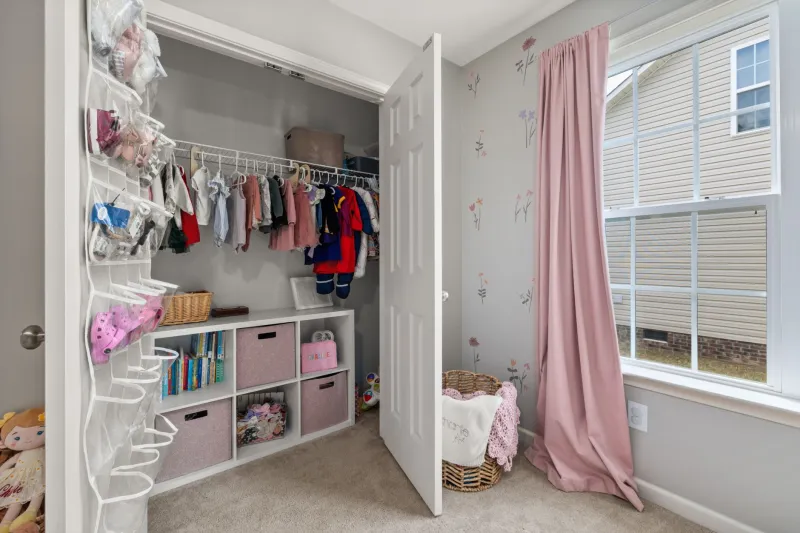
Check the obvious spots: nursery, changing area, living room play zone. Then check the less obvious ones: under beds, in closet corners, in the car, in the trunk, in diaper bags you haven't opened since the last pediatrician visit, in the garage, and in any "just for now" bins that have been sitting untouched for a while.
If you have a partner, do this together. One of you almost certainly knows where something is that the other has been searching for.
A Simple Way to Sort What You Find
Once you've located everything, sort it into four buckets — and you don't need fancy labels or a color-coded system to make this work.
Active use. This is the stuff you reach for every single day. It should be the most accessible, stored at arm's reach in the spaces where you actually use it.
Rotating use. Things you use sometimes — maybe weekly, maybe situationally. This gear can live slightly out of the way but shouldn't be buried. Think: the baby carrier you use for errand days, the travel sound machine, the spare swaddles.
Next-stage gear. Items your baby hasn't grown into yet, or things you're holding onto for a potential future baby. These belong in actual storage — labeled, sealed, and dated so you remember what's in there.
Done and decided. Gear that's past its useful life, that you genuinely won't use again, or that you've realized never worked for your family in the first place. This goes out — donated, sold, or recycled depending on condition and age.
The goal isn't minimalism. It's clarity. You can own a lot of stuff and still feel organized if you know what category everything falls into.
The Duplicate Problem (And What It's Really Telling You)
If your audit turns up multiples — two white noise machines, three sets of the same bottle brand, four pacifiers of a size your baby outgrew months ago — don't just feel embarrassed and move on. Duplicates are actually useful information.
They usually mean one of a few things: the item kept getting misplaced, so you kept buying replacements. Or the item was such a lifesaver that you panic-bought backups. Or it was gifted in multiples and you never consolidated.
For the first category, that's a storage problem — the item doesn't have a consistent home, so it wanders. Fix the location before you buy another one.
For the second, a little redundancy on truly essential items isn't the worst thing. Having a backup pacifier in the diaper bag and one by the crib is reasonable. Having seven is a sign you were operating in survival mode and buying your way out of anxiety, which — honestly — is understandable, but worth acknowledging.
Making Gear Findable When It Actually Matters
The best organization system is the one that works at your worst moment. Not when you're rested and motivated on a Saturday afternoon — but when it's the middle of the night, your baby is screaming, and you need the thermometer right now.
That means a few practical things:
-
Nighttime essentials get their own dedicated spot, and nothing else lives there. One drawer, one basket, one shelf — wherever works in your space. Thermometer, nasal aspirator, gas drops, extra pacifier, spare onesie. That's it. Nothing else goes in that spot.
-
Diaper bags get emptied and restocked after every trip, not just when you notice something is missing. A bag that gets restocked consistently is a bag you can actually trust.
-
Gear that moves between rooms needs a home base. The baby carrier, the portable rocker, the activity gym — if these travel around your house, designate one default location they return to. Otherwise, they disappear.
-
Storage bins get labels that actually describe the contents. "Baby stuff" is not a label. "6-12 month sleep gear" or "bottle accessories" is.
Before You Buy Anything New, Check the List
Here's the habit that makes all of this worth it: before you add something to your cart or your registry, check what you already have. Not in a vague "I think we have one somewhere" way — in a literal, look-at-your-sorted-inventory way.
This doesn't have to be complicated. Some parents keep a running note in their phone. Others use a shared list with their partner. Whatever format you'll actually use is the right one.
The point is to close the loop between what you own and what you buy, so you stop spending money on things that are already in your house — just waiting to be found.
Your baby's first year is already a lot to manage. Your gear situation doesn't have to add to it. A little time spent figuring out what you actually have can free up a surprising amount of mental space — and probably save you a few unnecessary Amazon orders while you're at it.